
- Services
- Products
- Applications
- Project Inspiration
- Contact Us
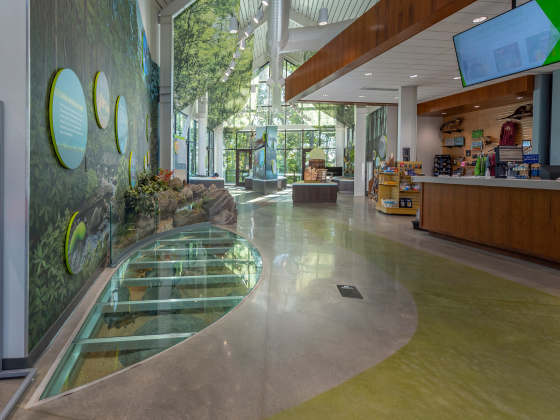
A structural glass floor is a system, not an insert. Its success depends on how the glass composition, framing, slip resistance, acoustics, and environmental conditions work together. GBA develops assemblies that reflect this balance: engineered to support expected live loads, designed to limit vibration, and detailed for long-term clarity.
Walking surfaces are treated to preserve transparency while maintaining traction; edges integrate with surrounding finishes; and each assembly is coordinated to meet the documentation expectations of metropolitan construction.
.png?width=1080&height=1080&name=ig%20mortarless%20glass%20block%20grid%20(2).png)
GBA brings decades of experience in engineered glass systems, supporting designers who aim to introduce light, openness, and spatial precision into complex interior programs. Our work involves early technical consultation, material configuration, fabrication management, and installation planning—critical steps in ensuring that a transparent structural surface performs as intended.
Whether integrated into a retail mezzanine, an entry sequence, a gallery overlook, or a residential connection, a GBA-engineered glass floor becomes a subtle but transformative design element: strong, quiet, luminous, and precisely tailored to the demands of New York architecture.
.png?width=560&height=420&name=email%20graphic%20560x420%20(12).png)
-1.png?hsLang=en)
.png?hsLang=en)
.png?hsLang=en)
.png?hsLang=en)
-1.png?hsLang=en)

"We could not be happier with your product and services. We relied on you quite a bit to set the coordination of several items – ceiling heights, curb construction, detailing/engineering – and can’t imagine having another vendor without your expertise and patience. Jeff was especially great throughout the entire experience.
100% will recommend you all here for any other projects in our office." — Neal Harrod, Rockwell Group
"I saw the final glass block wall in person and it really is a work of art. We are so grateful for your team’s hard work on this." – Crister Cantrell, Gensler
"Work was done very professionally with outstanding quality. Your crews were very attentive to detail & made sure to protect surrounding work surfaces from damage. They communicated well with my field team to ensure we & the Owner were satisfied with the end product. Job well done." - Russell Stafford, RNGD A Palmisano Company
"We were lucky to have GBA on our project at Lutheran East High School. From the front office to the field supervision and crew were very knowledgeable with our project. Took extra care not to damage the building during demolition. The quality of materials and their labor force was top-notch." — Peter Powell, Carey Construction Group
"We are extremely pleased with the outcome of the glass block at Lutheran East High School and have received many compliments on the design. The glass block windows give the building a nice “pop” of color on the exterior each side of the gym and helped to maintain the identity of the school." - Rick Jozity, Meraki Architects, L.L.C
"As the Senior Project Manager for the general contracting company responsible for completing all aspects of the historical restoration, structural rehabilitation, and adaptive reuse modifications to the derelict Triboro tuberculosis hospital, one of the most difficult challenges was finding capable and qualified subcontractors for the key restoration trades that are both committed to quality construction and respectful of the historical restoration process. I am lucky enough to have worked with GBA on previous successful projects and was glad to bring them into this project. GBA provided the essential expertise and quality craftsmanship that this project needed and was a reliable partner helping us convert the Triboro Tuberculosis Hospital into the T Building Residence." – Senior Project Manager, Bill Harwood for the GC, Mega Contracting
"On behalf of me, my project manager and CGC; I would like to reach out to applaud the quality and workmanship of the crew sent out to do the glass block wall outside of the theater here in Hudson. Dan and Nate went above and beyond to keep their work area organized and clean, even protected our finish trim and VWC in the mixing area with plastic. If only more companies active on site would follow in your companies steps these buildings would be cut and dry and run very efficiently. Thank you! - Jake M. Behler, Cameron General Contractors
"Working with GBA was seamless and the process of the work stood out. We had a few safety issues with the field crew but were quickly corrected and had no further issues during the course of construction. We are thrilled to be able to offer this product to the owner as they look much better than what was existing while offering the exterior grade capability that Atlantic Station needed. " — Garrett Atkinson, New South Construction
" It had been a pleasure working with GBA to install the glass block wall on our project. Your team has been nothing but professional and easy to work with. Your craftmanship in the field is top notch, and the glass block wall looks amazing. The masons in the field were very easy to work with and were hardworking. I would highly recommend GBA to other contractors and owners looking for a high quality Glass block wall. When you hire GBA you are getting quality professionals that deliver what they promise. " — Aaron Baver, Gordon H. Baver, Inc.
"It was a pleasure working with GBA on the 8615 & 8619 Westwood Center Glass Block replacement projects. The GBA project team was very knowledgeable and professional during the entire project. The quality of work and attention detail was superb. The site was kept clean and orderly with no complaints.
GBA handles all challenges in a timely and business manner. The coordination in the field and the office exceeded our expectations. I would not hesitate to higher GBA Architectural on any future projects." — Melissa R. Marletta, Encore Construction, Inc.
"Adam's European Contracting has had the pleasure of working with GBA Architectural Products + Services on the SCA IS293M/M218 Electrification project, located at 4600 Broadway, New York, NY 10040.
We are pleased to confirm that the project is currently ahead of schedule, with exceptional production performance. Field execution has been strong, efficient, and well-coordinated, reflecting a high level of professionalism and expertise.
Project management and supervision have been consistently effective, demonstrating clear communication, proactive planning, and thorough oversight. All required paperwork, documentation, submittals, and project controls have been properly maintained and kept up to date, contributing significantly to the smooth and successful progress of the work.
Overall, GBA Architectural Products + Services has performed excellently on the SCA IS293M/M218 Electrification project. Their work reflects reliability, strong leadership, and outstanding production capabilities. We would confidently recommend GBA Architectural
Products + Services for similar projects in the future." — Adam's European Contracting, Inc.